After the cuts and the defence come the chapters that are hardest to learn and most often skipped — and they are precisely the ones that decide whether drilled technique becomes fencing.
Chapter six, the withdrawal (Abzug). Meyer reminds the reader that a good beginning takes away half the work, but a bad ending can ruin everything that was done well before it. The withdrawal is not flight; it is how you end an exchange safely and avoid being hit at the moment the fight is already won.
Chapter seven, footwork. Speed, balance and position all begin with the feet. Meyer goes through every manner of stepping he uses across the whole system.
Chapter eight, the division of time. Vor, Nach and Indes — before, after, and in the instant. Three concepts on which every decision about when to act depends. You can fence without them, but not deliberately.
Chapter nine, putting the elements together. How parries, steps and attacks become one coherent and effective structure. Meyer shows here that the individual devices are not finished recipes but parts to be combined as the situation demands.
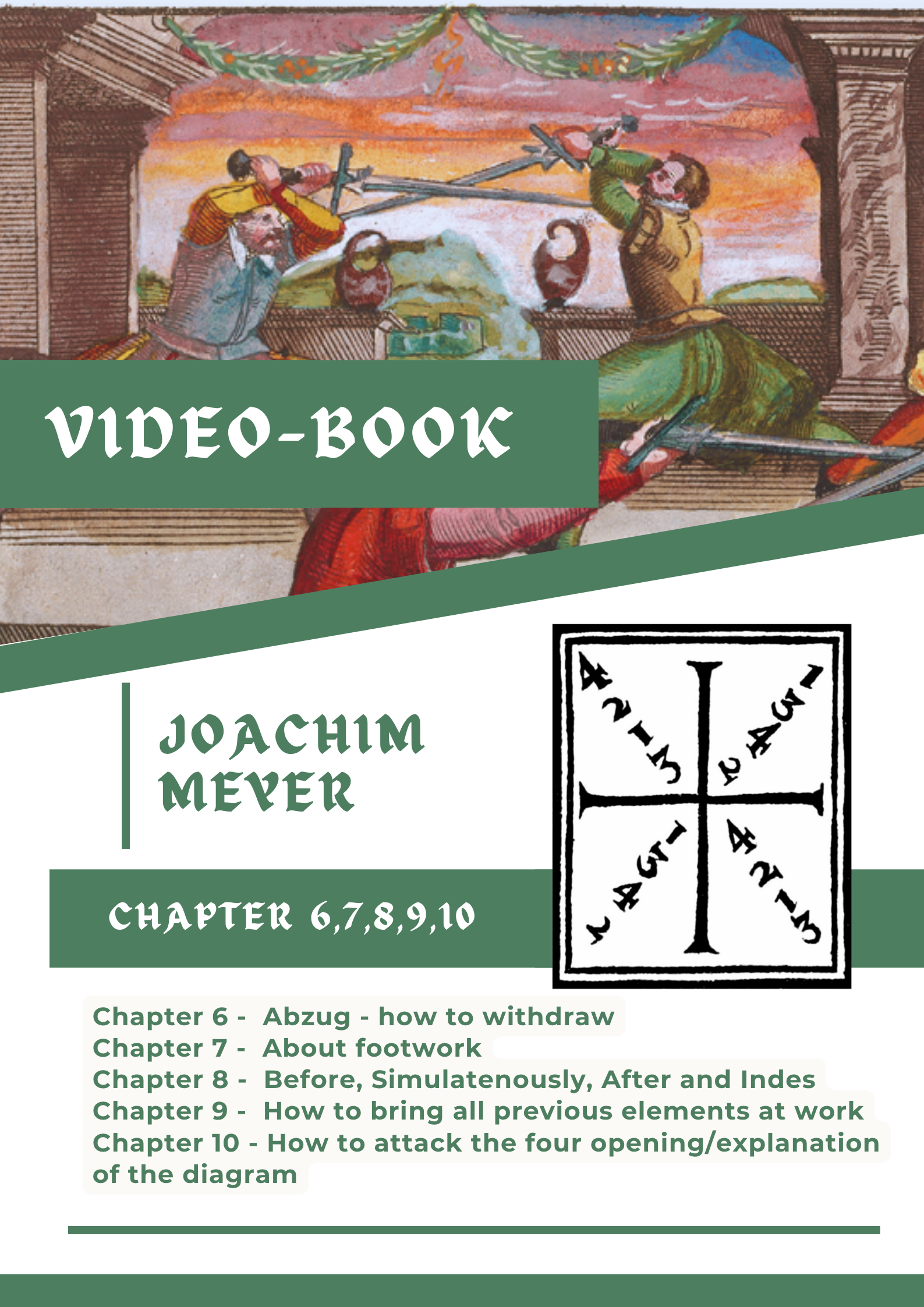
Chapter ten, attacking the four openings. Where to aim and why. It includes the difference between full and empty strikes, and an explanation of Meyer's diagram for striking with a practical demonstration.
How the video-book works
The video-book is two separate products and the link between them: a PDF e-book and a playlist of 9 videos on our streaming platform. The e-book is not an extract — you get Meyer's complete 1570 treatise in your language. The videos concentrate on chapters 6 to 10 and follow the written form page by page and move by move.
Nine videos is fewer than in the earlier instalments, and for a reason: these chapters are not a stock of devices but a set of principles. One video per chapter, plus the treatment of full and empty strikes and of Meyer's diagram. Short, dense, and the part you will come back to most often.
What the video-book contains
- A PDF e-book of Meyer's complete 1570 treatise
- A playlist of 9 videos covering chapters 6 to 10
- The withdrawal, footwork, the division of time, the structure of a device, and attacking the four openings
- The difference between full and empty strikes
- An explanation and practical demonstration of Meyer's diagram for striking
Who it is for
For fencers who have the technique and want to give it order. Anyone who has worked through the cuts and the defence has the tools; these chapters say when to use them, how to get to the opponent and how to get away again. For instructors it is material for the part that is hardest to teach, because it cannot be seen — timing, and the construction of a whole.
The video-book is not a substitute for training or for an instructor's guidance. The performances follow Meyer's text and keep to its reading.