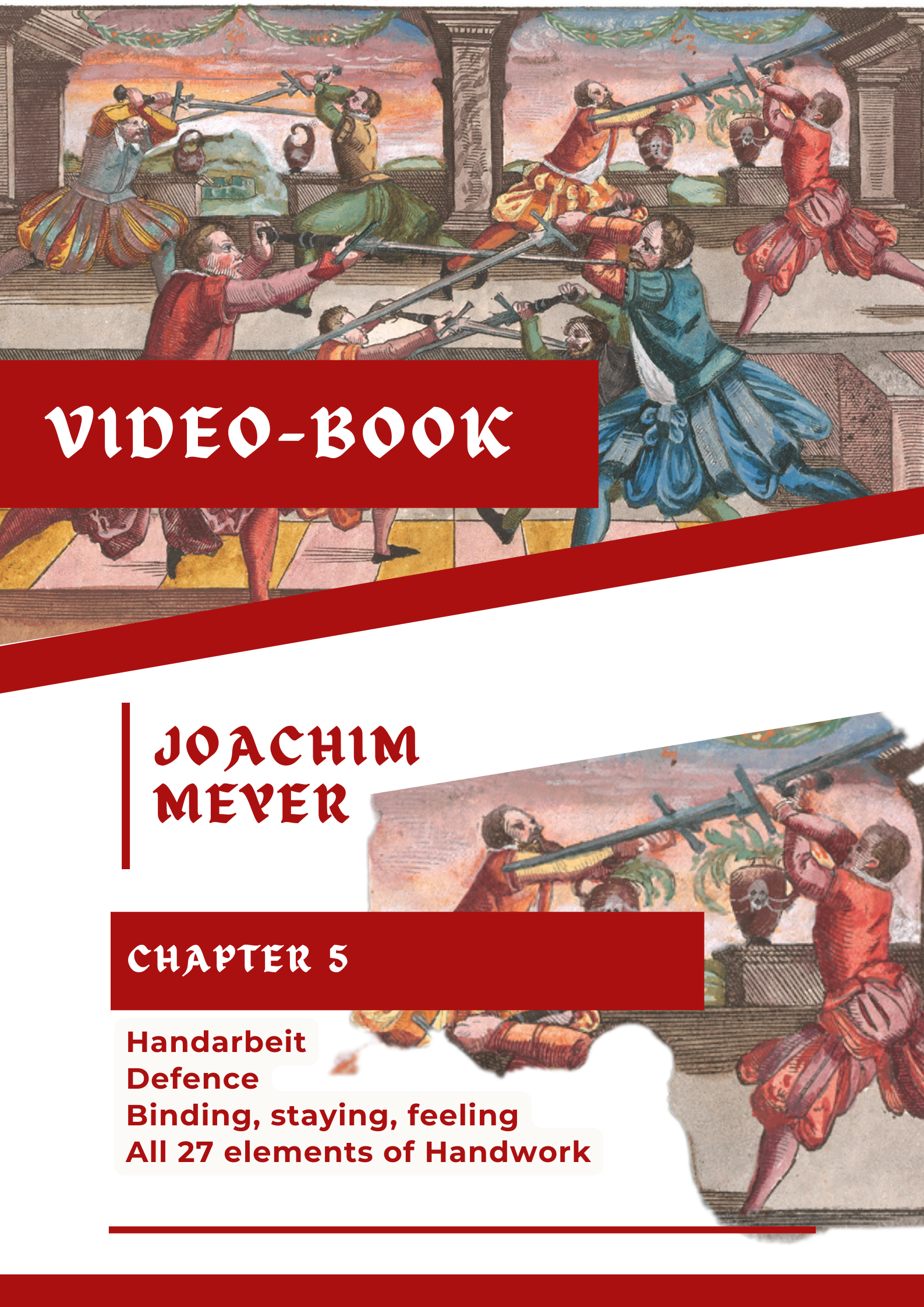
J. Meyer 1570 Longsword — chapter 5, On defence· videobook
What happens once the blades meet. The fifth chapter of Meyer's 1570 treatise is devoted to defence — the Handarbeit, the work in measure, where an encounter is actually decided. The video-book combines an e-book of Meyer's complete treatise with a playlist of 29 videos filmed from this chapter. A fencer who can only defend simply loses more slowly; Meyer teaches you to defend in a way that becomes an attack.
Secure payment
Instant access
No physical shipping
Meyer divides every encounter into three parts: the Zufechten, the onset and the approach; the Handarbeit, the work in measure once the blades have met; and the Abzug, the withdrawal. The fifth chapter is given to the middle one — and that is where a fight is usually decided.
Meyer's idea of defence is the opposite of what the word normally suggests today. Defence here is not a block after which the fencer stops and waits to see what comes next. It is an action that turns the opponent's blade aside and opens your own way to the hit in the same motion. Whoever merely covers hands the initiative to the other man and loses more slowly. That principle runs through the whole chapter.
This is why the fifth instalment is the one experienced fencers reach for — the ones for whom it "more or less works" in drill, but who find themselves in free play constantly answering what the other man does rather than setting the terms. The chapter shows exactly where that situation turns.
How the video-book works
The video-book is two separate products and the link between them: a PDF e-book and a playlist of 29 videos on our streaming platform. The e-book is not an extract — you get Meyer's complete 1570 treatise in your language. The videos concentrate on chapter five and follow the written form page by page and move by move. Twenty-nine recordings is the fullest coverage in the series so far: it goes down to the level of the individual play, not a handful of overview clips.
You can work with it two ways. Read the text and use the videos to check what each passage looks like in motion. Or simply follow the videos and pick up the teaching quickly, without wrestling with period language first. Both lead to the same place: the authentic instruction of one of the greatest sword masters of the sixteenth century, studied at your own pace.
What the video-book contains
A PDF e-book of Meyer's complete 1570 treatise
A playlist of 29 videos covering chapter five
Every instruction Meyer gives on defence, page by page
Several camera angles on every movement
Who it is for
For fencers who have the cuts and the guards in hand and have hit a ceiling: it works in drill, but in free play they stay on the back foot and never get a say. For instructors it is material for a block of lessons on what to do after the first contact of the blades — the part that is hardest to teach and most often missing.
The video-book is not a substitute for training or for an instructor's guidance. The performances follow Meyer's text and keep to its reading.
Fencersguild.com
Order:
Product name:
J. Meyer 1570 Longsword — chapter 5, On defence· videobook